
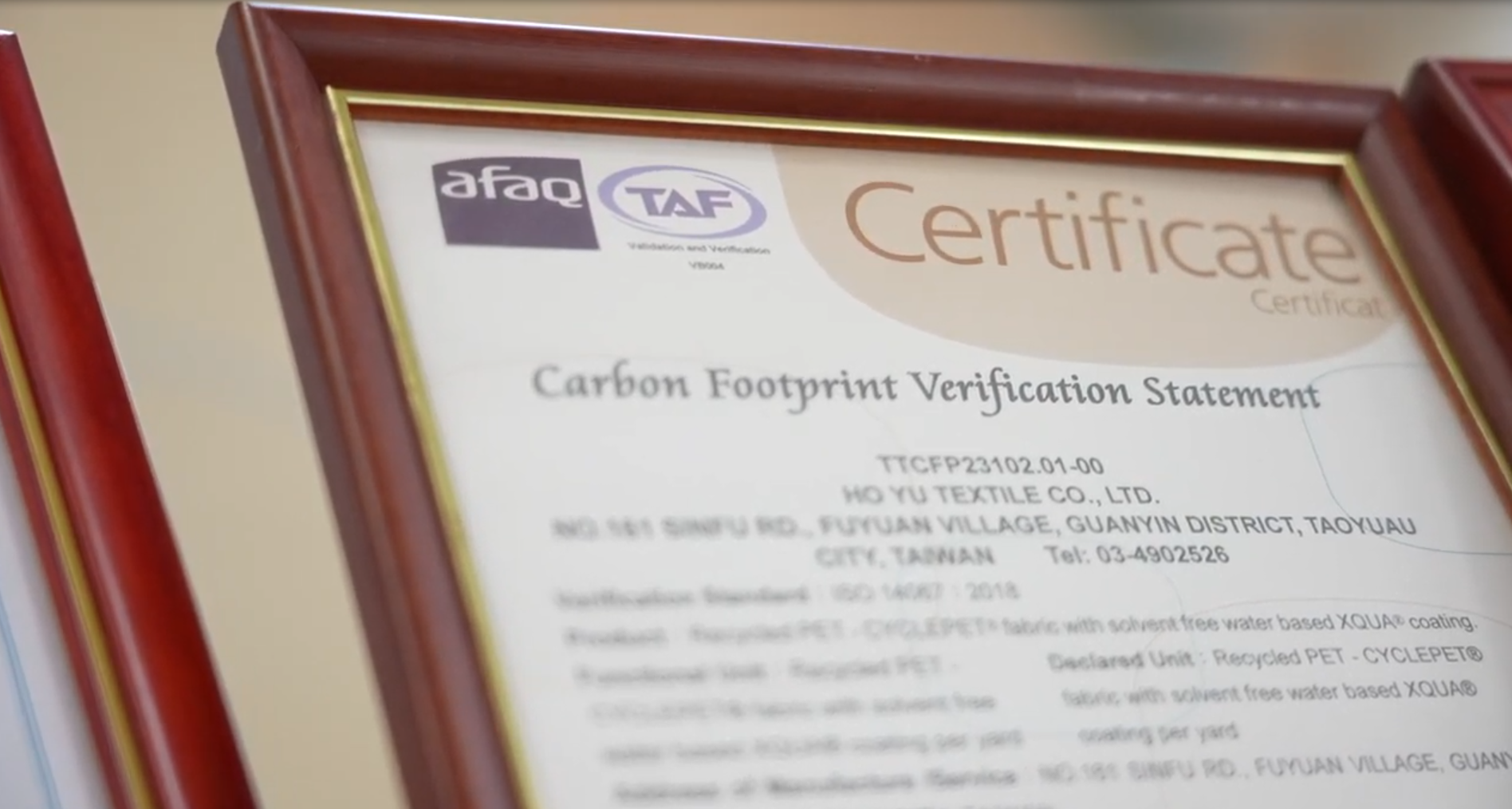
The global textile industry is one of the world’s most carbon-intensive sectors, second only to petrochemicals, with annual emissions exceeding 2.1 billion tons—around 10% of global carbon output. In Taiwan, textiles form a critical part of the manufacturing landscape and account for 6.6% of total industrial emissions.
For many years, HOYU Textile has invested in sustainable materials such as CYCLEPET recycled PET yarn, ocean-recovered textiles, and solvent-free aqueous adhesives. However, we also recognize that true decarbonization cannot rely solely on material innovation or renewable energy. It requires a fundamental strengthening of the factory’s overall operational structure.
In July 2024, HOYU joined a government-led decarbonization program, aiming to systematically optimize our production processes—through raw material substitution, equipment upgrades, and process improvements. Following the principle of “leading by example,” we also sought to empower our supply chain partners toward the shared goal of net-zero emissions.
Through this program, HOYU collaborated with ten supply chain partners, engaging in technical consulting, performance validation, and knowledge sharing to collectively promote low-carbon transformation across the value chain.
From July 1, 2024 to June 30, 2025, HOYU Textile achieved a total carbon reduction of 10,014.06 tons of CO₂e through the use of low-carbon raw materials, process optimization, and equipment improvements—representing an approximate 41% reduction, with 2022 as the baseline year for carbon inventory. Among the key contributors was the adoption of HOYU’s self-developed XQUA® solvent-free, low-carbon adhesive, which played a major role in enhancing the decarbonization outcome. We also recommended integrating XQUA® into printing materials for one of our supply chain partners to support future sustainable material development trends.
The project successfully concluded in October 2025. For HOYU, the greatest challenge was aligning diverse operational conditions and business models across different suppliers. Yet the greatest reward was seeing these partners come together—each developing new insights and momentum toward decarbonization.
A decade ago, “carbon reduction” felt distant and abstract. By 2025, it has become one of the key strategies for market differentiation. HOYU Textile will continue advancing the sustainability of the supply chain and accelerating low-carbon innovation in both materials and manufacturing to meet the sustainability challenges ahead.